
Over the past few weeks, as a student in the Master of Clinical Psychology (MCP) program, I’ve been bombarded with an overwhelming amount of information. The material is rich and complex, and while it has sparked so many new ideas, it has also led to a heightened level of mental stimulation — sometimes leaving me feeling a bit overwhelmed. The topics I’ve been diving into — from trauma and neuroplasticity to mental illness (a term I’m not entirely comfortable with, but that’s another conversation) — have prompted me to question, learn, and reflect deeply on my own experiences and understanding of the world.
In the middle of all this information, I had the kind of serendipitous experience that made everything click. During my Psychopathology and Case Formulation class, I listened to a podcast by Brené Brown featuring Dr. Bruce Perry. His discussion on little t and big T trauma was a revelation for me, particularly in understanding the differences between my own experiences and those of my sister. We both experienced little t trauma, but in very different ways — that’s a whole book I might get to one day! My sister, for example, developed mental and emotional health issues largely due to the cumulative effect of little t traumas — smaller, often overlooked events that, together, had a profound impact on her. Later in life, she experienced a number of big T traumas, which compounded the effects of her earlier experiences, leading to more complex mental health struggles. These issues have been further exacerbated by prolonged elevated cortisol levels, affecting her physical health as well. Dr. Perry’s podcast helped me understand how the nuances of little t trauma can add up and have long-lasting effects, especially when compounded by more severe events.
Then, as if the universe was giving me exactly what I needed, I came across Dr. Gabor Maté. His work on trauma and its impacts almost put me into a trance. His words, so eloquently spoken, made me feel warm and safe, as if I were being gently led into a deeper understanding of myself and the world around me. Dr. Maté’s ethos — that trauma shapes not just our emotions but the very wiring of our brains — resonated deeply. He speaks with such compassion and insight, offering a way forward by reframing how we view trauma: not as something that defines us negatively, but as something that has shaped us, and something we can heal from.
The final piece of this puzzle came with Dr. Daniel Amen’s podcast, where he discussed the need for mental health professionals to start looking at the brain itself when diagnosing and treating mental health conditions. The realisation that we, as practitioners of mental health, often don’t consider brain scans or brain health when diagnosing mental conditions is, frankly, astonishing. Dr. Amen highlighted that, just as a heart specialist would never make a diagnosis without looking at heart scans, we should be doing the same for the brain. This radical focus on brain health instead of disorders and “mental illness” was refreshing and eye-opening. Dr. Amen stressed that by taking care of the brain, we ultimately take care of the mind, which made complete sense to me. It was a reminder that the mind and body are deeply interconnected, and to truly understand mental health, we need to understand how the brain works. AMEN! Dr. Amen!
Around this time, I also found myself caught in the swirl of social media content. I started seeing videos about ADHD popping up in my Facebook and TikTok feeds. People were describing behaviors that sounded eerily familiar to me, like how I think, how I react to certain situations, and how I struggle to switch attention when I’m deep in my head. The more I watched, the more I thought: “Maybe I have ADHD?” But then, my scientific rational brain kicked in, and I slapped myself in the face (figuratively, of course) and said, “Why are you diagnosing yourself based on TikTok’s and Facebook reels?!” This was a moment of clarity for me, realising that while I might exhibit ADHD-like traits, there is a much larger context at play — my upbringing, my life experiences, and my trauma.
This led me to a pivotal realisation: my thought patterns, while certainly divergent from the “norm,” may not necessarily be rooted in a biological condition. Instead, they might be the product of a unique environment that I grew up in. I have since come to see these behaviors as neurodivergent-adjacent, but more accurately, I believe they are Traumadivergent — shaped by my early experiences rather than biology alone.

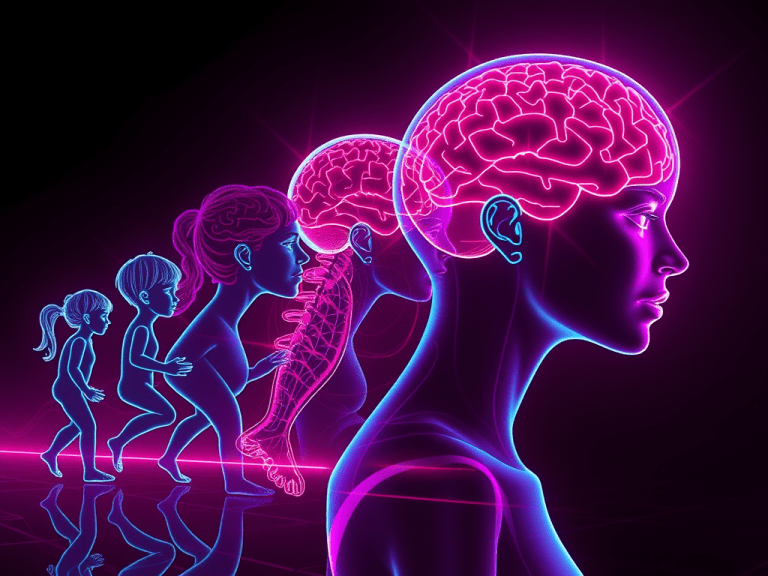
Trauma is an undeniable part of the human experience, one that profoundly shapes our development and growth. Divergence, too, does not have to carry the negative stigma that society sometimes attaches to it. Traumadivergence is not a diagnosis or condition like neurocognitive disorders. Instead, it’s a term that describes a process fundamental to how we develop — the way early life experiences, particularly trauma, influence our brain function and structure. It’s a way to group together the effects of these experiences, offering a framework for understanding how they shape differences in thinking, behavior, and emotional processing. This concept aims to acknowledge that trauma and early experiences can create unique cognitive and emotional patterns, influencing how we see and interact with the world.
The research is already out there, but I hope to make these ideas more palatable and understandable — not only for the academic community but for me, for my sister, and for anyone else who may feel that their experiences don’t fit neatly into existing categories. After taking Dr. Amen’s Brain MD “What’s Your Brain Type” quiz and discovering that my brain type is overactive in the ACG (anterior cingulate cortex), I found myself understanding even more how trauma has shaped my cognitive processing. It all clicked into place, and I began to see myself and my experiences from a different perspective.
So, here I am, diving deep into a rabbit hole of research, reflection, and learning, ready to explore and explain neurodivergence and how it relates (or differs) from Traumadivergence. I aim to uncover how our early life experiences — and the trauma embedded within them — might shape the brain in ways that mimic neurodivergent traits. And, through this journey, I hope to help others understand that sometimes it’s not about being “neurodivergent,” but rather being Traumadivergent.
As I embark on this journey to explore Traumadivergence, my approach will be one of deep inquiry and reflection. I intend to examine the most current research on trauma, neuroplasticity, epigenetics, and neurodivergence, comparing and contrasting these findings with my own experiences and observations. My goal is not only to understand how trauma shapes cognitive and emotional patterns, but also to explore where the research aligns with or challenges my concept of Traumadivergence. Throughout this exploration, I will draw from the work of experts like Dr. Bruce Perry, Dr. Gabor Maté, and Dr. Daniel Amen, while also critiquing areas where the research may fall short or fail to account for the complexities of lived experience. The topics I intend to explore include:
- Trauma and Brain Development
- Epigenetics and Trauma
- Neuroplasticity and Trauma
- Neurodivergence vs. Traumadivergence
- Practical Implications for Treatment and Support
By blending research with personal insights, I aim to provide a holistic view of Traumadivergence, shedding light on how early-life trauma shapes the brain and behavior, and offering a new lens through which we can better understand cognitive and emotional diversity.
 Traumadivergent